Valorant’s Ranked Journey: From Beta Delays to a Competitive Titan
Valorant's ranked mode was heavily anticipated during the closed beta, with Riot Games meticulously testing before launch.
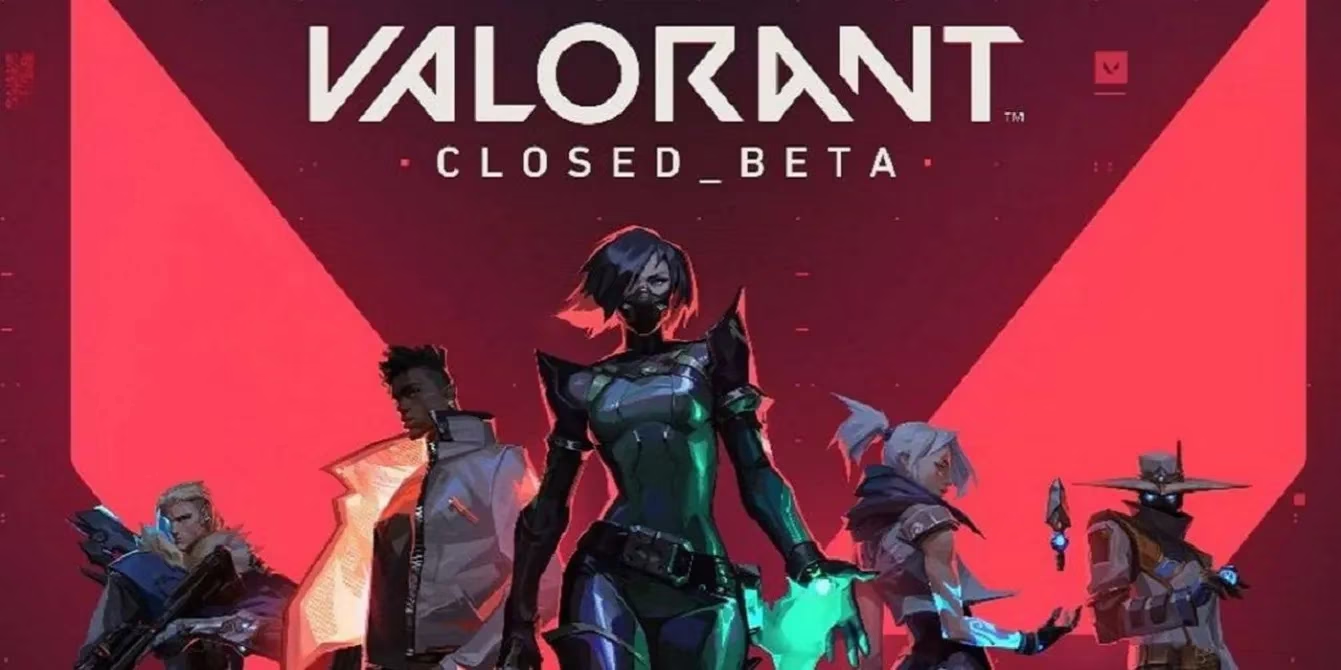
Back in the spring of 2020, Valorant’s closed beta had taken the shooter world by storm. Players had barely learned the difference between a Jett dash and a Raze blast, yet one question was already burning on everyone’s lips: “When does ranked mode drop?” The craving for a structured ladder was so intense that some solo queue warriors were posting scoreboards showing them carrying teams with double the kills of anyone else, just to prove they needed a proper ranking system. But Riot Games, the ever-meticulous parent of this newborn tactical shooter, wasn’t about to rush things. No, sir. Ranked mode sat patiently in the wings, like a stagehand waiting for the perfect cue, while the developers observed the chaos of unranked matches and took copious notes.
Game director Joe Ziegler would eventually break the silence on a Friday afternoon, replying to a frustrated player with a tiny nugget of hope. “First tests of ranked mode are happening in the next couple of weeks,” he tweeted on April 10, 2020, telling the community to “stay tuned.” Those words spread faster than a Viper smoke. Everyone immediately started doing mental math: if tests go well, maybe — just maybe — ranked arrives before May. But, as any veteran Riot observer knows, the road from “testing” to “live” is rarely a straight line. The ranked mode had to learn how to walk before it could sprint, and its teachers were a bunch of developers who would rather fix a thousand bugs than let an unfair match ruin someone’s evening.
Behind the scenes, Riot was hustling to build more than just a ranking system. They wanted Valorant to become an esports heavyweight, and that meant preparing the arena. An early announcement confirmed that blood could be toggled off in professional matches — a small detail, sure, but it showed Riot’s willingness to fine-tune every knob. Partnerships with streamers, tournament organizers, and content creators were forged, laying the groundwork for a scene where ranked would serve as both a proving ground and a scouting tool. But the real ace up Riot’s sleeve was Riot Direct, the company’s own ISP initiative. By giving Valorant a higher server tick-rate, they aimed to slash lag and make sure every headshot felt crisp. Ranked players, after all, have a special kind of fury reserved for dying behind a wall. “If you’re gonna lose, lose fair and square,” as the saying goes. That technical backbone would become the ranked mode’s best friend — no one likes a victory tainted by a rubberbanding connection.
Yet even with the infrastructure humming, the ranked mode had to wait. In April 2020, a game-breaking bug with Cypher let him spy through floors in ways that would make any competitive match a farce. A hotfix patched that up, along with several map exploits that let players slip into walls like they were ghosts. For the ranked mode, these were necessary detours. “What’s the point of stretching your legs if the track is full of potholes?” you could almost hear the ranked mode whisper, if abstract concepts could speak. Riot knew that releasing a broken ladder would poison trust, so they sanded down the rough edges first, even if it meant enduring a few more weeks of casual chaos. The ranked mode would emerge not with a bang, but after a series of quiet, careful nods from the QA team.
By the time summer 2020 arrived, Valorant launched in full, and its ranked mode stepped into the spotlight. It was no longer a shy debutant. It had structure: tiers from Iron to Radiant, placement matches, and a grind that could either inflate egos or crush them entirely. Fast-forward to 2026, and that once-tentative ranked mode now sits at the very heart of Valorant’s identity. It has weathered agent releases, map reworks, and countless meta shifts with the resilience of an old sea captain. The ladder itself has gone through overhauls — rank decay, Ascendant tier added, Act-based resets — each change informed by millions of matches and an ocean of player feedback. The partnership esports ecosystem Riot dreamed of has blossomed into a global circuit where ranked solo queue heroes regularly get scouted by pro teams. And Riot Direct? It quietly hums along, making those clutch 1v5 moments possible with a tick-rate that still turns heads.
The ranked mode’s journey from a whispered promise in a tweet to the competitive pillar of a generation is, frankly, a little unbelievable. It was never just about a badge next to a name; it was about creating a world where every Phoenix flash and every Killjoy turret placement felt meaningful. The mode has seen celebrations, heartbreaks, and more than a few smashed mouses, but through it all, it has stood as proof that patience and polish pay off. Somewhere, in a parallel universe, a rushed ranked mode fell flat on its face on day one. Here, however, the story played out differently… and it’s still being written every time someone queues up, takes a deep breath, and clicks “Competitive.”
Comments