Valorant's Twitch Viewership: 6 Years After the 24/7 Fake Stream Scandal
Valorant's closed beta drops fueled a wave of fake Twitch streams and artificial viewership, questioning if the problem was ever fixed.
I still vividly remember the spring of 2020. As an eager FPS player, I was desperate for a Valorant closed beta key. Like hundreds of thousands of others, I did what any sensible gamer would do: I opened Twitch and let a Valorant stream run 24/7, muted, minimized, while I slept or worked. It felt like a game – not the actual game, but a meta-game of endurance against Riot's randomness. That experience wasn't unique. It was the engine behind one of the most controversial viewership booms in Twitch history. And honestly, even in 2026, I still find myself asking: did we ever truly fix the fake-stream problem, or did we just get better at ignoring it?
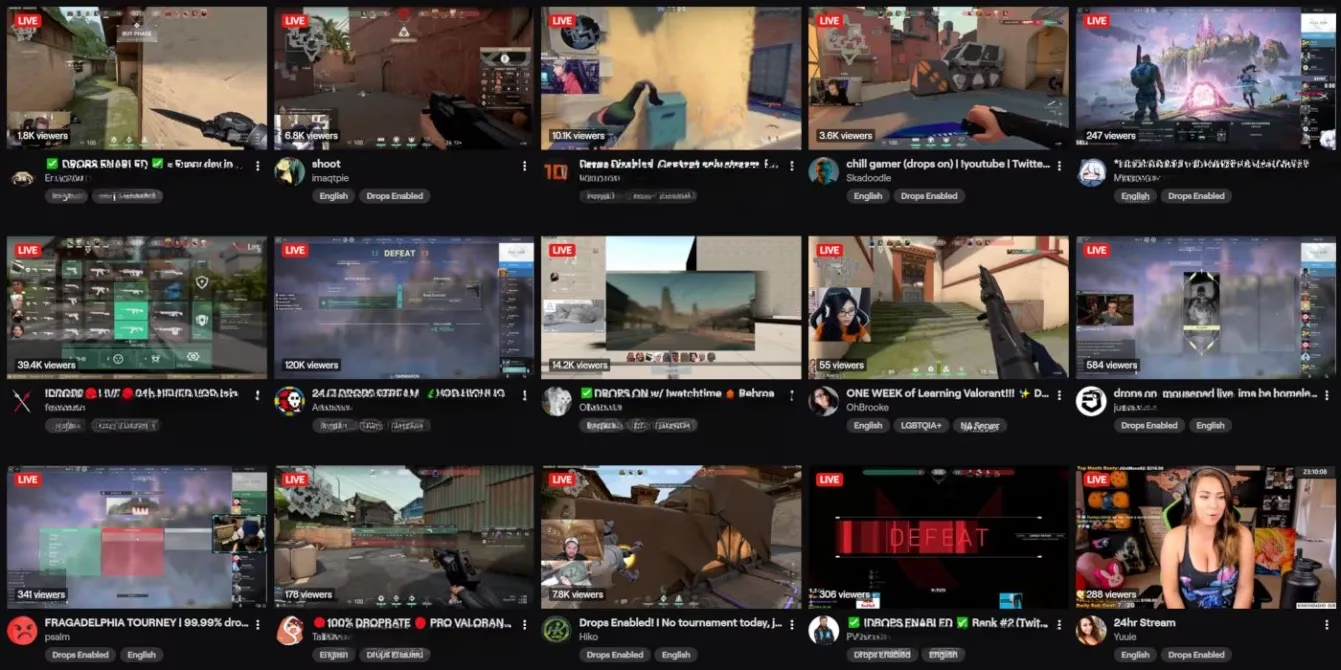
Back then, Valorant's closed beta access was tied directly to watching streams on Twitch. Riot Games' system randomly dropped keys to viewers, with the catch that more watch time improved your odds. The result was an overnight explosion of channels broadcasting nothing but a looping "Stream live for drops!" title, often with the streamer completely absent. By mid-April 2020, Valorant's category routinely topped Twitch with hundreds of thousands of concurrent viewers – even at 3 a.m. ET. On the surface, it appeared Riot had instantly created the next esports juggernaut. In reality, a massive chunk of those viewers were bots, idle accounts, or people like me who weren't actually watching.
Popular streamer Summit1G couldn't hold back his frustration during a 2020 broadcast. "This is the absolute fakest section on Twitch right now," he declared, calling the proliferation of AFK streams "disgusting." He went on to disable his own Valorant drops, admitting the situation accelerated his burnout. His sentiment resonated across the community. Why would anyone support a real, engaging streamer when an AFK looping video supposedly offered the same chance at a precious key? That question cut to the core of a dilemma that has since repeated itself in launch after launch. Even though I understood the tactical reasoning – if you wanted a key, you had to game the system – it felt fundamentally unfair to creators who actually put effort into entertaining their audience.
So what happened after that explosive beta? Fast forward to 2026, and Valorant is no longer the untested newcomer. It's one of the most polished tactical shooters on the planet, with a thriving esports circuit and regular seasonal content. Riot quickly phased out the watch-for-key drops once the game launched in summer 2020, replacing them with the more conventional Prime Gaming loot and occasional drops tied to official tournament broadcasts. That solved the specific problem of beta-key inflation, but did it solve the broader culture of artificial viewership? In my opinion, it merely shifted the battlefield.
Even today, you can find echoes of the 24/7 AFK meta. Some content creators run endlessly looping Valorant highlight reels while they're offline, farming ad revenue from viewers who might not even realize the stream isn't live. More importantly, the entire model of "engagement farming" has become more sophisticated. In 2026, Twitch still struggles with "always-on" channels that broadcast pre-recorded content under the guise of live gameplay. And let's not forget the rise of view-botting services that are harder than ever to detect. I sometimes scroll through the Valorant category late at night and see streams with suspiciously high viewer counts but zero chat activity. Are those real people, or has the ghost of 2020 never really left? 🎮
To put the evolution into perspective, let's look at a simple comparison between the 2020 beta frenzy and the state of Valorant's Twitch category in 2026:
| Metric | April 2020 (Beta) | October 2026 |
|---|---|---|
| Peak concurrent viewers | 1.7 million | 420,000 |
| Estimated % of viewers considered "non-active" | 40–60% | 8–15% |
| Key driver of viewership | Closed beta key drops | Esports events + new agent releases |
| Community sentiment on fairness | Highly negative; accusations of "faking" | Mostly positive, though suspicion remains |
| Primary 24/7 stream method | AFK key-farming channels | Pre-recorded replay channels & view-botting |
As the table suggests, the scale of artificial inflation has dramatically dropped, but it hasn't disappeared. Riot's more transparent systems today – like requiring viewers to complete interactive quests during broadcasts to earn in-game items – have certainly helped. Yet, whenever a new agent or a major championship rolls around, I still see a surge of those suspiciously silent streams. The core dilemma remains unchanged: as long as platforms and publishers reward watch time without verifying genuine engagement, someone will find a way to exploit the gap.
Why do I care so much about this as an ordinary player? Because it warps our entire perception of a game's health. In 2020, news headlines screamed that Valorant was "the most-watched game on Twitch" before most people had ever played it. That hype sold skins and attracted sponsors, but it also created unrealistic expectations. What if the real number of interested players was far smaller? The bubble could burst, and communities built on inflated metrics often collapse when the bots are removed. Even in 2026, I see indie developers tempted to replicate the "watch-and-earn" model, thinking it's a shortcut to viral success. Without remembering the lessons of that chaotic closed beta, we're doomed to repeat the same mistakes.
But maybe there's a twist. Perhaps the fake-viewership problem ultimately benefited Valorant by accelerating its word-of-mouth. After all, I only installed the game because I was already jonesing for it after hours of staring at a muted stream. The artificial numbers drew in curious newcomers, who then became genuine players. It's a cynical perspective, but I can't completely dismiss it. Was the fakery a necessary evil in a hyper-competitive launch market? 🤔
From a creator's standpoint, the damage was real. Small and mid-sized streamers who couldn't – or wouldn't – run AFK streams saw their discoverability tank. Why would Twitch's algorithm push a lively, entertaining channel with 50 viewers when a dead stream with 5,000 bots dominated the category? This created a chilling effect where authenticity was punished. Even in 2026, I hear from up-and-coming streamers who feel pressured to adopt scummy tactics just to survive the first few pages of a saturated game category. The Summit1Gs of the world could afford to turn off drops; the newcomers could not. This power imbalance hasn't gone away; it's just hiding beneath a cleaner surface.
Riot, for its part, has never publicly apologized for the 2020 fiasco, but their actions speak. They now restrict drops to specific, sanctioned esports streams and frequently run anti-bot sweeps alongside Twitch. The 2026 VCT Masters event, for instance, featured a “timed engagement” mini-game that required viewers to click a prompt every thirty minutes to remain eligible for rewards. This killed the AFK exploit almost entirely for that event. Still, I wonder: why did it take six years and thousands of frustrated creators to get here?
As I wrap up, I'll pose the question that keeps nagging me: Are we, the players, partially to blame? We willingly participated in the 24/7 meta because we wanted the keys. We rewarded the fake streams with our views, teaching platforms that numbers matter more than content. Today, when I see a Valorant channel with a suspiciously static webcam and a generic overlay, I just click away. But not everyone does. If we want a fair, creative streaming ecosystem, we have to actively choose authenticity – even when it's less convenient.
Valorant's journey from beta key madness to legitimate esports titan is a testament to the game's quality. Yet, the 24/7 fake stream scandal remains a cautionary tale. It showed how easily numbers can be gamed, how algorithms can be twisted, and how a community's desperation can be exploited. As we move further into 2026, with ever more immersive games and even more intricate reward systems, we must keep asking ourselves: Are these viewers real, or are we just staring at another beautiful illusion? 🌐
Comments