Valorant's 2026 Domination: How a Pandemic-Era Phenomenon Became a Streaming Leviathan
Valorant’s Twitch closed beta strategy ignited a new era in competitive gaming and streaming, revolutionizing online entertainment.
Back in 2020, I remember watching Valorant’s closed beta explode across Twitch like a supernova in a digital galaxy—sudden, brilliant, and utterly consuming. Fast forward to 2026, and I can confidently say that moment wasn't a flash in the pan; it was the Big Bang for a new era of competitive gaming and streaming symbiosis. While the world was locked indoors, Riot Games and Twitch orchestrated a masterstroke, tethering beta access to live streams and creating a viewing behemoth that racked up a staggering 334 million hours watched in a single month. That initial surge was just the first tremor. Today, looking back, that period feels like watching a humble sapling rapidly mutate into a colossal, data-siphoning redwood, its roots now inextricably woven into the very infrastructure of online entertainment.
The Genesis of a Viewing Juggernaut
The strategy was deceptively simple yet fiendishly clever. To get a precious beta code, you had to watch. And watch we did. Twitch became a digital watering hole where millions gathered, not just for entertainment, but with the palpable, shared hunger for access. This wasn't just streaming; it was a participatory event, a global digital queue. The numbers from that April are still mind-boggling: 334 million hours dedicated to Valorant on Twitch alone, accounting for a colossal 22% of the platform's total 1.5 billion hours watched that month. The partnership between Riot and Twitch was less of a deal and more of a psychic link, perfectly attuned to the pandemic-altered rhythms of our lives. Other platforms felt the ripple effects too:
| Platform | Hours Watched (April 2020) | Year-on-Year Increase |
|---|---|---|
| Twitch | 1.5+ Billion | +99% |
| YouTube Gaming | 461 Million | +65% |
| Facebook Gaming | 291 Million | +238% |
This wasn't merely growth; it was the tectonic plates of viewership shifting in real-time. Valorant became the flagship vessel navigating this new, swollen ocean of attention.
From Beta Experiment to Permanent Fixture
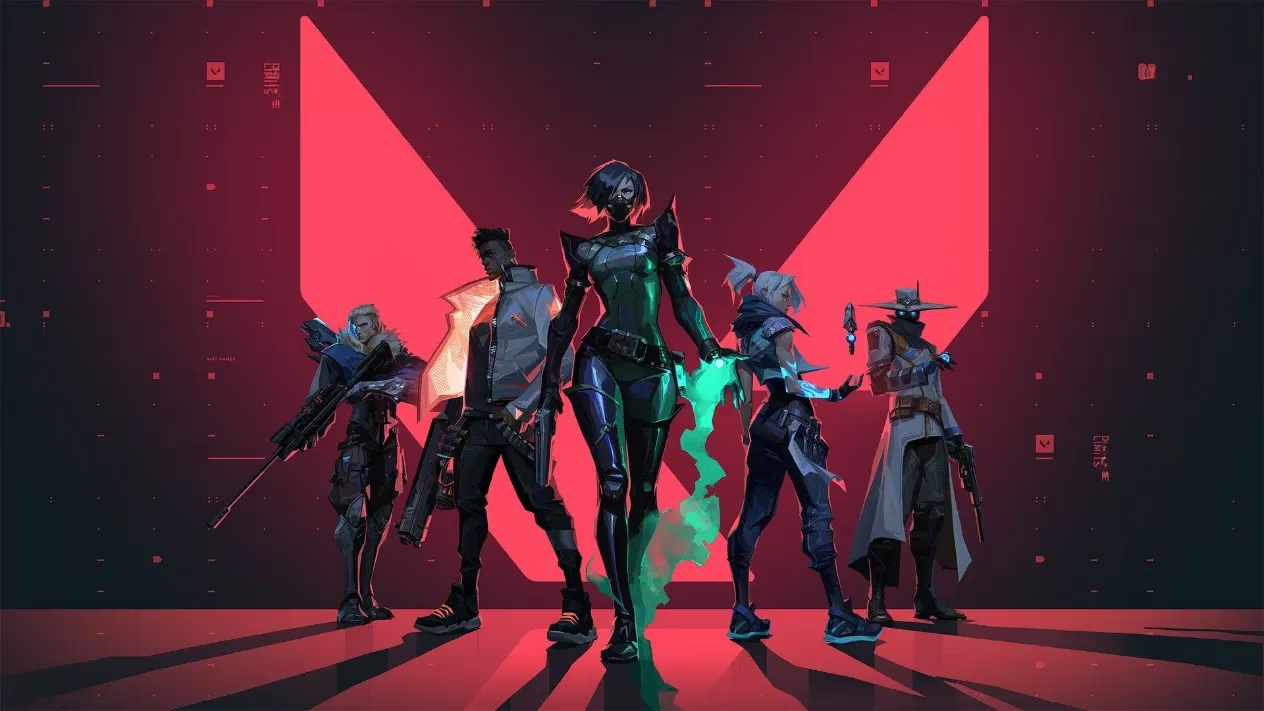
That initial beta period proved something fundamental: the line between playing and watching could be blurred into irrelevance. The game itself, a precise 5v5 tactical shooter, was like watching a high-stakes chess match played with lightning reflexes and particle-beam weapons. Its clarity and strategic depth made it a perfect spectator sport. While the final version did launch later in 2020 as planned, the console question lingered. Here in 2026, we've seen Riot's "consideration" evolve into a multi-platform empire. The game's presence is now ubiquitous, but its soul remains on PC, where that original, rabid community first took root. The legacy of those early days is a viewing culture as dedicated as the player base. Major tournaments now pull viewership numbers that make that initial 334 million hours look like a quaint warm-up act.
The Ripple Effects and the New Normal
The success of Valorant's launch strategy did more than just break records; it wrote a new playbook. It demonstrated that game access could be a currency, and viewer attention its mint. This model has since been iterated on, refined, and sometimes clumsily copied, but few have replicated that perfect storm of timing, product quality, and platform integration. The pandemic-driven surge in streaming (Twitch's near-doubling of hours year-on-year) was the kindling, and Valorant was the spark. Today, the landscape it helped define is the status quo. Watching streams for drops, early access, or in-game loot is as normal as checking the weather. The platforms that rode that wave, particularly Facebook Gaming with its insane 238% growth, cemented their places in the hierarchy.
In retrospect, April 2020 was a pivotal month. We weren't just watching a new game; we were witnessing the acceleration of gaming's future. Valorant was the catalyst, a hyper-efficient enzyme that sped up the reaction between content creation and consumption. It went from being a closed beta to a cultural pillar with the speed of a data packet crossing a fiber-optic cable. Its journey from a Twitch-exclusive key dispenser to a multi-platform titan is a masterclass in modern game development and marketing. For me, it solidified a truth: in today's world, a game isn't just played; it's lived, watched, and dissected in a global, always-on arena. The lines have forever blurred, and we have that initial, record-shattering beta to thank—or blame—for it.
Comments