The Five-Year Odyssey of Valorant's Ascent: A Map Woven into the Game's Soul
Valorant Ascent map development reveals a captivating five-year evolution, transforming tactical shooter design with innovative, adaptive gameplay.
In the ever-evolving landscape of competitive gaming, few tales of creation are as profound as the genesis of Ascent, a battleground that emerged from a half-decade crucible within Riot Games. The revelation, shared by level design lead Chris Carney and senior game designer Salvatore Garrozzo, was not one of mere development time but of a symbiotic evolution. Ascent did not simply take five years to build; it grew, adapted, and matured alongside the very essence of Valorant itself, its foundations laid even as the game's core philosophies were still being forged in the fires of iteration. This was not a puzzle to be solved, but a living organism, its design perpetually adjusting to the pulsating demands of the tactical shooter taking shape around it. For a map that feels fresh to players, its roots delve deep into the primordial soil of Valorant's inception.
🔍 The Prototype and Proving Ground
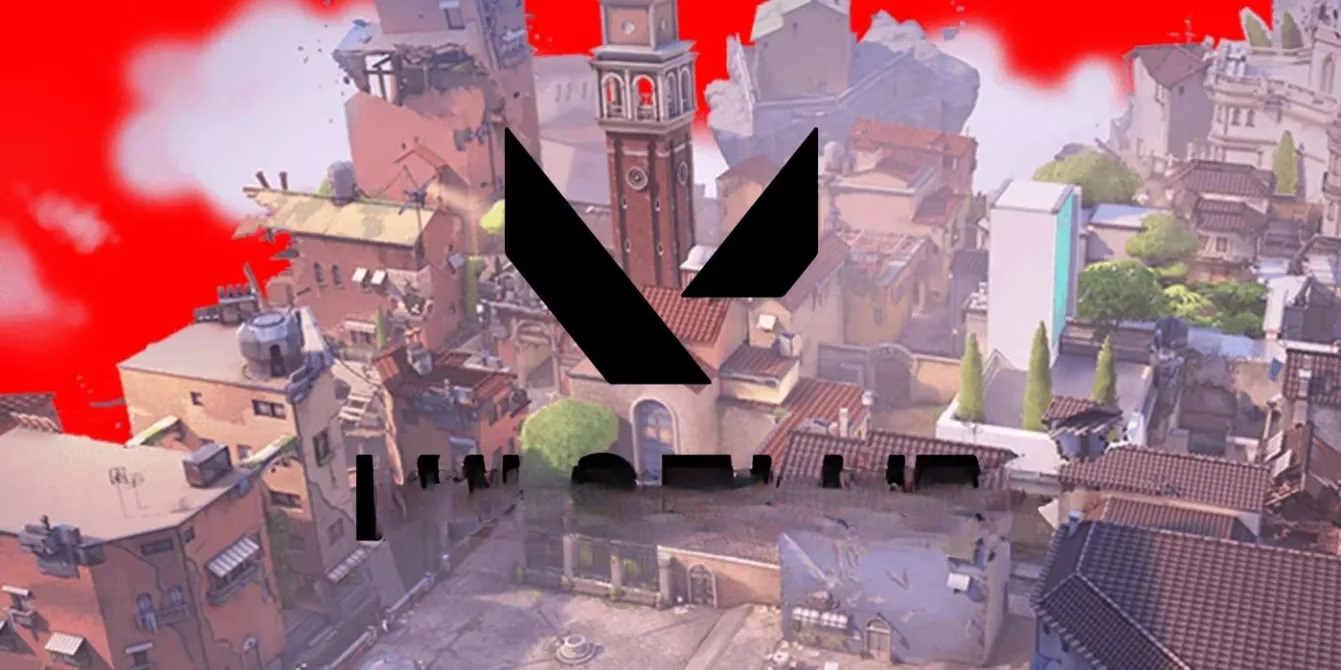
Long before it bore the name Ascent, this map served as the primary laboratory for Valorant's defining principles. It was here, on these digital cobblestones and within these Venetian-inspired plazas, that the game's intricate dance of gunplay and agent abilities was first choreographed. The map became the canvas upon which Riot's designers tested the delicate equilibrium between:
-
Tactical Space Control: The creation of meaningful chokepoints, long sightlines, and vertical layers.
-
Ability Synergy: Ensuring agent kits could interact with the environment in dynamic, yet predictable, ways.
-
Strategic Clarity: Balancing complexity with intuitive navigation to allow for both structured executes and creative improvisation.
This foundational role imbued Ascent with a unique DNA. While other maps might be designed to fit a finalized game, Ascent helped define the game. Its Mid Courtyard, with its central orb and multiple entry points, became a masterclass in creating a high-stakes, multi-vector conflict zone that rewards coordinated team play and sharp map awareness.
⏳ An Evolution, Not Just a Construction
The staggering timeline—contrasting sharply with the typical one-year map development cycle—speaks to a philosophy of relentless refinement. Ascent's journey mirrors the broader narrative of Riot Games' expansion from a MOBA titan into a multi-genre powerhouse. Just as Teamfight Tactics refined the autobattler and Legends of Runeterra reimagined the digital card game, Valorant sought to distill the essence of tactical shooters. The map evolved through countless iterations, each tweak a response to shifting internal meta, weapon balance changes, and the emergent behaviors of playtesters.
| Development Phase | Primary Focus | Impact on Final Design |
|---|---|---|
| Conceptual & Prototyping (Years 1-2) | Establishing core gameplay loops and spatial language. | Created the map's foundational three-lane structure with a heavy mid focus. |
| Integration & Iteration (Years 2-4) | Adapting to evolving agent abilities and weapon mechanics. | Fine-tuned choke points, cover placement, and orb/ult point locations. |
| Polish & Playtesting (Year 5) | Balancing for competitive integrity and visual clarity. | Finalized lighting, sound cues, and the distinctive "destructible doors" mechanic. |
🎭 A Divisive Masterpiece
Upon its release, Ascent was met with the passionate dichotomy reserved for landmark competitive maps. Its design philosophy—favoring methodical, information-based play—cemented its status. Players either revered its depth or critiqued its pace. This divisiveness is perhaps the ultimate testament to its successful design; it possesses a strong, unwavering identity. It doesn't try to be all things to all players but instead offers a specific, demanding challenge. Key areas that define the Ascent experience include:
-
The Catwalk / Tree Room Dynamic: A tense vertical duel that separates the skilled from the strategic.
-
The A Main to Site A Execute: A perilous approach demanding precise utility usage and team coordination.
-
The B Site Retake Scenarios: Complex angles and post-plant positions that test a team's adaptability under pressure.
🌟 The Legacy of a Foundation
In 2026, as Valorant stands as a pillar of the esports world, Ascent's legacy is clear. It is the paradox: the oldest soul in a young body. The lessons learned during its five-year gestation period undoubtedly informed the development of every subsequent map, from the neon-drenched streets of Lotus to the mysterious ruins of Abyss. It proved that a map could be more than just a stage; it could be a foundational pillar, a silent teacher of the game's deepest strategies. The commitment to such a lengthy, iterative process signaled Riot's dedication to quality and their understanding that in a game of milliseconds and meticulous planning, the environment is as crucial a character as any wielding a Phantom or a Vandal.
The story of Ascent is a poetic reminder that in game development, as in art, true mastery often lies not in the speed of execution, but in the patience of evolution. It is a map that did not merely get built; it was cultivated, pruned, and allowed to breathe alongside the game it was destined to define. Its cobblestones hold the echoes of five years of experimentation, making every match played upon it a continuation of that grand, ongoing creative journey.
Comments