The Ever-Present Guardian: VALORANT's Anti-Cheat in 2026
VALORANT and Riot Vanguard spark fierce debate over esports security versus privacy, highlighting deep concerns in the gaming community.
It was a rainy evening in 2026, and Alex sat staring at the glowing screen, hesitating over the download button. The icon for VALORANT—a game that had dominated esports for six years—beckoned. Yet a nagging thought whispered in the back of his mind: Is it really worth letting Riot Vanguard sink its claws into my PC?
Six years after its controversial launch, Riot Games’ anti-cheat system remained a topic of heated debate. Vanguard, the kernel-level driver that activates the moment a computer boots, had not retreated from its original design. If anything, it had only grown more embedded. For players like Alex, who valued security and privacy, this was the ultimate dilemma.
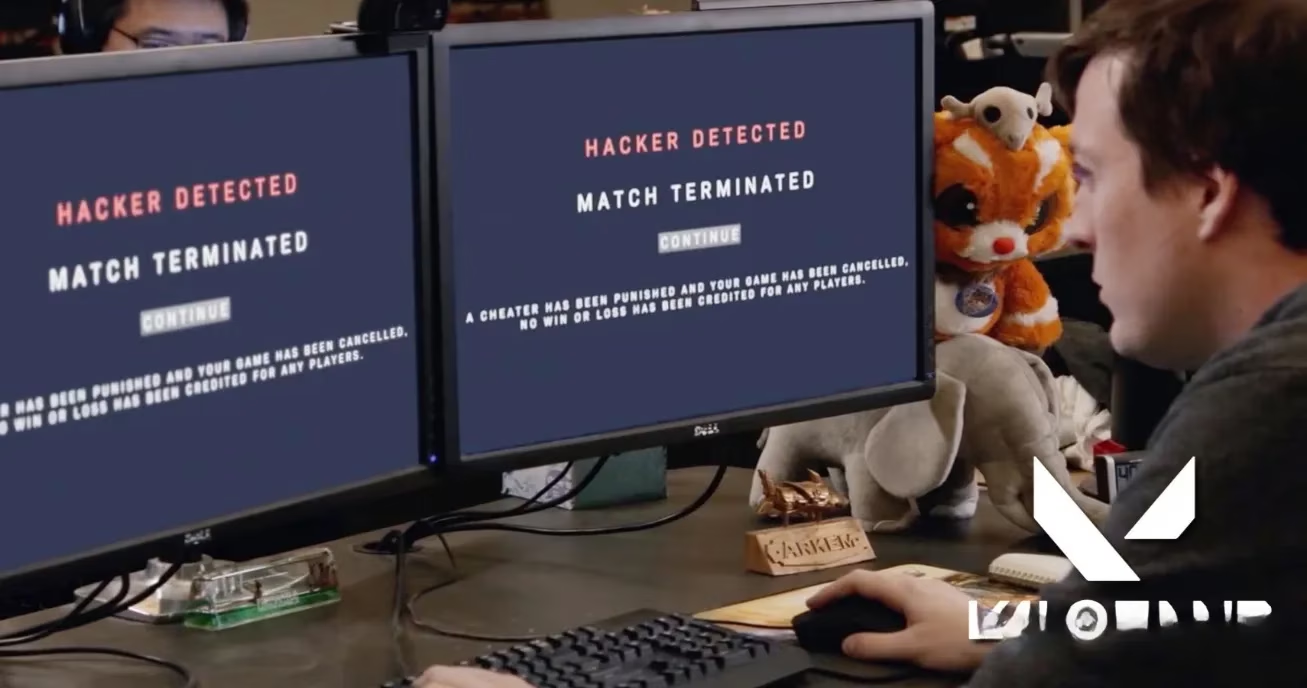
To understand Alex’s hesitation, one must rewind to 2020. When Riot first unveiled Vanguard, it promised an aggressive stance against hackers. The system needed deep access—ring-0 privileges—to detect cheats before they could even interact with the game. A Riot representative at the time explained bluntly, “Vanguard needs this depth of access to stop aggressive cheaters.” That meant the driver ran continuously, from the moment the operating system booted, monitoring memory and processes. The community split instantly: some praised the iron fist, while others cried foul over privacy invasion and potential security holes.
Those fears were not unfounded. A Reddit user had illustrated a nightmare scenario: if Vanguard itself were compromised by a malicious update, users who didn’t immediately patch could be left vulnerable. In the years since, that scenario hadn’t materialized—no major breaches were publicly disclosed—but the theoretical danger clung to every discussion. Could a future zero-day exploit turn Vanguard from guardian to Trojan horse? And if it did, how many would even notice before damage was done?
Fast forward to 2026, and Vanguard had evolved. Riot addressed some early concerns by allowing users to disable the driver when not playing, though it would require a system reboot to re-enable it. The anti-cheat had also expanded to other Riot titles, creating a unified security platform. Yet the fundamental bargain remained unchanged: to enjoy VALORANT’s crisp, competitive gameplay, one had to grant a third-party company near-total oversight of their system. Alex, a cybersecurity-conscious engineer, found this unnerving. Why should a game have the same access level as an operating system kernel? What if the data collected—even if supposedly anonymized—could be misused?
The gaming community in 2026 was accustomed to such trade-offs. Many accepted Vanguard as a necessary evil to keep their matches free from aimbots and wallhacks. After all, cheating scandals still plagued tournaments and ranked ladders. Without a rigorous approach, VALORANT’s integrity would crumble. But that didn’t silence the dissenters. Online forums buzzed with questions: Does Vanguard really need to scan all running processes, even those unrelated to the game? Why can’t it work like an on-demand scanner that activates only when VALORANT launches? Riot’s answer remained consistent—hackers adapt, and partial protection is no protection at all.
Yet the skeptics had more arrows in their quiver. By 2026, privacy watchdogs had published reports showing that kernel-level drivers could theoretically harvest telemetry beyond cheat detection. No proof of Riot abusing this capability surfaced, but the mere possibility kept some players awake at night. Alex remembered his friend Lena, who had quit VALORANT after two years. “It’s not about what they’re doing now,” she’d said. “It’s about what they could do if leadership changed, or if a government leaned on them. Once you open that door, it’s hard to close.”
For Alex, the decision came down to a simple calculus. He recalled the famous phrase from the early days: “The obvious solution is simply not to play the game if one is so concerned.” That bluntness hadn’t softened over time; if anything, Riot’s confidence in Vanguard was now backed by a six-year track record of relatively clean ranked play. Yet trust is personal. Could Alex trust a corporate entity to never overstep? Could he trust that Vanguard’s code was airtight against both external attackers and internal abuse?
He thought about his friends, who had been playing since the beta. They shrugged off the concerns. “I’ve never had a problem,” said one. “My PC is still mine,” said another. But anecdotal safety wasn’t proof. The question lingered: Is it better to live in fear of a rare theoretical attack or to miss out on one of the greatest multiplayer shooters ever made?
Alex poured a cup of coffee and made his choice. He clicked “Install,” knowing that the moment his PC restarted, Vanguard would take its silent post in the background, like a digital sentinel that never sleeps. He didn’t feel entirely comfortable—but then again, what worthwhile journey ever began without a leap of faith?
Whether you agree with his decision or not, one thing is certain: Vanguard is here to stay. Riot Games wagered that players would value a cheat-free environment over absolute control of their systems—and for the most part, they were right. As long as cheaters exist, the arms race between offense and defense will demand ever-deeper ties into the hardware we own. The real question isn’t whether anti-cheat systems like Vanguard will persist, but what boundaries we are willing to draw—and who will draw them for us.
Comments