Bunny Hopping in VALORANT: How to Move Faster and Counter Sage’s Slow Orb
Master Valorant bunny hopping to slip past Sage’s Slow Orb, preserving momentum and confounding enemies.
Since its launch, VALORANT has built a reputation for blending precise gunplay with distinctive agent abilities. Even years into its lifespan, the game continues to attract players from every corner of competitive gaming — from tactical shooter veterans who spent thousands of hours in Counter-Strike, to MMO and battle royale refugees looking for something fresh. For newcomers stepping into this high-stakes environment in 2026, bridging the skill gap can feel daunting. One movement mechanic that consistently helps players seize an early edge, regardless of their background, is bunny hopping. Mastering this technique not only raises an agent’s speed ceiling but also unlocks creative ways to dance around powerful area-denial tools.
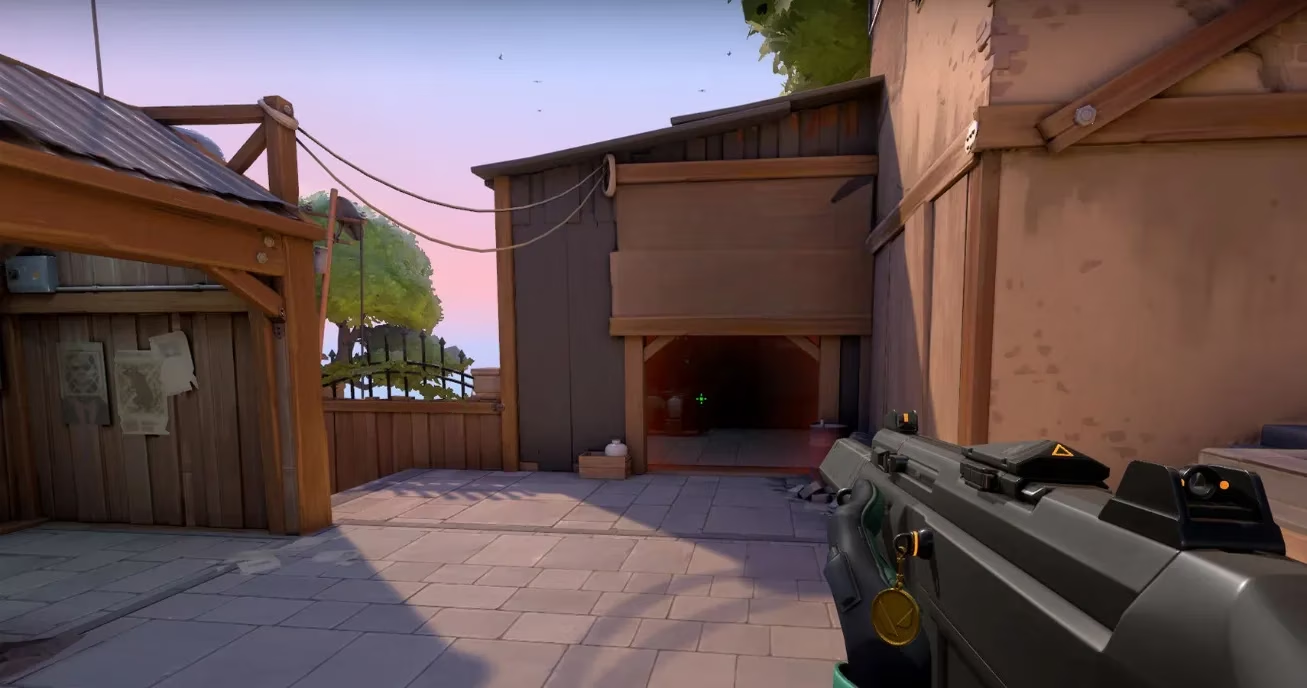
Bunny hopping has deep roots across FPS history. Long before VALORANT arrived, titles like Quake, Team Fortress, and even earlier iterations of Counter-Strike turned the maneuver into a rite of passage for movement enthusiasts. The core idea remains unchanged: by chaining together angled jumps, a player preserves momentum that normally dissipates when landing on the ground. The result is a sprint-like glide that feels almost weightless — and it can outpace a standard running animation. Reddit user Jack_Dice crystallized the technique for the VALORANT community, posting a visual guide that broke down the necessary inputs and clarified just how valuable the skill can be in live matches.
Executing a bunny hop looks deceptively simple. A player jumps while holding a directional key and simultaneously flicks the mouse slightly to one side. As soon as they touch the ground, they immediately jump again, this time swinging the mouse in the opposite direction. Throughout the sequence, the camera stays pointed forward, which keeps the crosshair aligned with potential threats. The magic lies in air strafing — those minute, mid-air adjustments that transfer lateral momentum into forward speed. When timed perfectly, each consecutive hop stacks velocity until the player is zipping past corners at a pace that feels almost unfair. It is a rhythm game wrapped inside a shooter, and it demands practice to stop the hops from collapsing into clumsy, single-direction bunny hops that actually slow a player down.
Why go through the effort? In VALORANT, bunny hopping counters one of the game’s most oppressive control abilities: Sage’s Slow Orb. Whenever a patch of crystalline ice spreads across the floor, typical foot movement turns into a crawl. Agents who attempt to walk or run through it become easy targets. A crisp bunny hop, however, drastically reduces the time spent in contact with the ice. Because the technique minimizes ground friction, a hopping player can slice across the entire radius of a Slow Orb with startling momentum, often escaping a situation that would otherwise spell certain death. This single interaction gives bunny hopping incredible defensive and aggressive utility, allowing duelists to push through chokes that defenders assume are safely locked down.
Beyond countering Sage, bunny hopping gifts players map-wide rotational speed. Consider a scenario where a teammate falls on the opposite site, and the spike is already ticking toward explosion. Conventional sprinting might take 10 or 12 seconds to loop around. A well-executed string of hops can shave off valuable moments, leaving more time to isolate the final opponent and plant or defuse under pressure. That extra second often decides rounds. Similarly, post-plant scenarios reward players who can rapidly reposition between cover without producing constant footstep audio. Hopping, when paired with precise air control, generates a quieter, more unpredictable movement signature that can confuse enemies holding angles.
Getting comfortable with bunny hopping is primarily a journey of muscle memory. Most players begin in the Practice Range, where the open floor and dummies remove the stress of real combat. There, a person can experiment with different jump timings, listening for the subtle audio cue that signals the perfect moment to leap again. A common drill involves bunny hopping in figure-eight patterns around the range’s pillars, gradually increasing speed until the motion feels natural. Another effective exercise places an orb or a puddle from a custom game to simulate a Slow Orb, forcing the player to hop through it repeatedly while keeping their crosshair locked on a stationary bot. Over weeks, the inputs become as automatic as counter-strafing or switching weapons.
It is worth noting that VALORANT’s movement system has been tuned over the years to prevent truly infinite air strafing, so bunny hopping does not infinitely accelerate like it did in some classic arena shooters. Still, in 2026 the technique remains an indispensable part of high-level movement kits. Top streamers and professionals seamlessly weave one or two hops into their peeks, using the burst of speed to swing a corner unpredictably. Some combine a single bunny hop with Jett’s Tailwind or Neon’s slide to create hybrid dashes that cover enormous distances. These evolutions show that bunny hopping is not a stale relic; it is a living, adaptable tool that continues to find new life as the agent roster expands.
For players still finding their footing, the best advice is to start small. Attempting long hop chains during a round will likely end in frustration. Instead, focus on integrating a single clean hop when retreating from a bad angle or when rushing to help a teammate. As confidence grows, so will the length and fluidity of the chains. Many community-made aim trainers and custom VALORANT lobbies now offer dedicated movement courses that gamify the learning process, complete with speed meters that provide instant feedback. Those resources lower the barrier to entry significantly compared to the early days of trial and error on live servers.
In the end, bunny hopping embodies that special intersection between mechanical skill and creative expression that keeps VALORANT eternally interesting. Whether a player is a former CS:GO fragger or completely new to tactical shooters, investing time into this movement art reaps immediate rewards. It transforms Sage’s ice from a threat into a mere suggestion, accelerates rotations across sprawling maps, and injects a little extra unpredictability into every duel. As the year 2026 pushes competitive norms higher still, those who can glide through the chaos with silent, graceful hops will always stand one step ahead.
Comments